Monday, August 10, 2015

Google’s Internet balloons

Google’s Internet balloons will soon connect all of Sri Lanka with Wi-Fi

It will be the first country in the world to have universal Internet coverage.


Google has teamed up with the Sri Lankan government to deliver broadband Internet to every region of the island nation, making it the first country in the world to have universal Internet coverage.
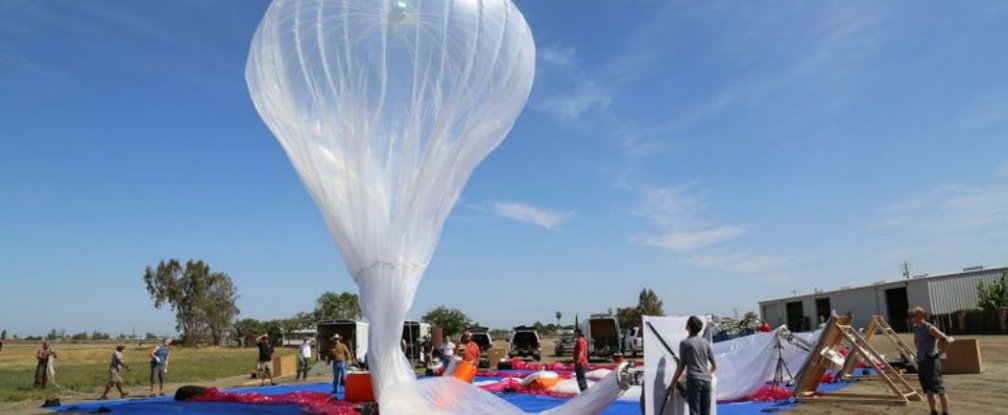
The initiative is part of Google’s Project Loon, which aims to provide cheap or free Wi-Fi to people in remote rural areas around the world via a fleet of huge helium-filled balloons floating way up in the stratosphere.

Right now, of the 22 million mobile phones being used in Sri Lanka, 2.8 million of them are connected to the Internet, so if the initiative goes ahead, it could change a whole lot of lives. "Hopefully in a few months every person and every device on the island will be covered by 3G," Sri Lanka’s Deputy Minister of Economic Development, Harsha de Silva,


As part of Project Loon, Google plans to launch a network of high-altitude balloons into the sky, each capable of beaming a wireless signal to the ground below.
The ultimate goal is to provide internet to the two-thirds of the world that currently isn't connected, and also help bring Wi-Fi to the poorest and most remote regions, as well as those areas struck by natural disasters.
The benefit of the balloon distribution method is that countries don't have to invest in laying underground cabling in order to increase the coverage of their networks. but using solar-powered drones instead.
As part of the partnership, Telstra will offer Google access to its base stations and a segment of its 2.6 GHz spectrum. And in December, 20 balloons carrying Telstra's Wi-Fi signal will be launched across the Queensland outback to see how well the project works in practice.
These balloons will be floating around twice as high as passenger planes - the system works by having grounded stations bounce Wi-Fi signals off the balloons. The balloons then reflect the signal along to each other, and each time it hits a balloon, Wi-Fi signal is transmitted down to a large area on the ground.
The balloons' machinery is solar powered, and the devices can stay floating for around 100 days.
In the future, Google plans to lease its balloons out to wireless providers around the world, rather than buying access to their wireless spectrum.
While the project definitely has noble goals, it’s faced a few setbacks so far - trial flights of the balloons have resulted in destroyed power lines and mistaken reports of a plane crash. 
But if these first internet trials are successful, Google will only have the hurdle of working out how to keep the balloons floating in one place to overcome.
No word yet on how much Telstra would be charging people to access their balloon-beamed Wi-Fi signal.

sanjeewa hettiarachchi

Friday, December 19, 2014

Intel Wireless Charging Coming Soon

Intel Wireless Charging Coming Soon


Currently, the Qi wireless charging standard is the leading standard in the wireless charging industry, Intel though is trying to change that by giving their own wireless charging option. According to Kumar Chinnaswamy, the General Manager of Wireless Charging in Intel, there are a few smartphones ready to use Intel’s new wireless charging, what these devices are, we still  don’t know. Another interesting thing is that Intel’s wireless charging will also be  integrated into notebooks and tablets.
Regarding wireless charging inside laptops, the high to mid end laptops will be getting the treatment first starting at the first quarter of 2015, with the low end offerings will start 2 years after on 2017. The laptops coming with Intel’s wireless charging is said to have the Intel Core M series chips running inside.
I am assuming though that only smartphones running Intel’s own chip will dawn their very own wireless charging technology. I am only speculating this, but I believe it is a likely possibility.
More information regarding Intel’s wireless charging is currently unavailable and we still don’t know how their technology will work. It will be quite interesting to see how their rendition of wireless charging will compete with the current Qi wireless charging standard.

wireless charger (new)

Wireless Charger


Air Dock 2.0 Comes With New Features And More Ways To Mount


From the people behind Air Dock, the wireless mobile device charger that you can mount on your car’s windshield comes the second version of this travel-friendly device for people on-the-go. This new setup for the well-received Air Dock – dubbed Air Dock 2.0, comes with new features and gives more mounting options making it more flexible than it already is. Air Dock 2.0 is currently available for crowdfunding via IndieGoGo.


For starters, Air Dock uses Qi wireless charging technology as an energy bridge to charge your smartphone from the mounted dock. To connect your smartphone onto the dock, all you need to do is place it so that the back of your phone is in contact with the surface of the dock. Your phone then sticks to the dock and stays there. This is made possible because of the nano suction foam that’s present on the dock’s surface. That’s actually a deal-maker for those who think that wires are too messy and clips aren’t too reliable.


Air Dock 2.0 add more options for mounting the Air Dock onto your car. Of course, there is the standard way of doing it, one in which you simply stick one end onto a smooth surface such as your car windshield. Another is when the Air Dock stick to textured surfaces, and the third option lets you mount the dock onto smooth surfaces (like the first one) but it comes with a flexible rod that you can bend to fit your preferences. To those who don’t really use their CD players much, the fourth mount has a flat part which you can slip into your CD-player’s slot, leaving the dock to stick out of it.